
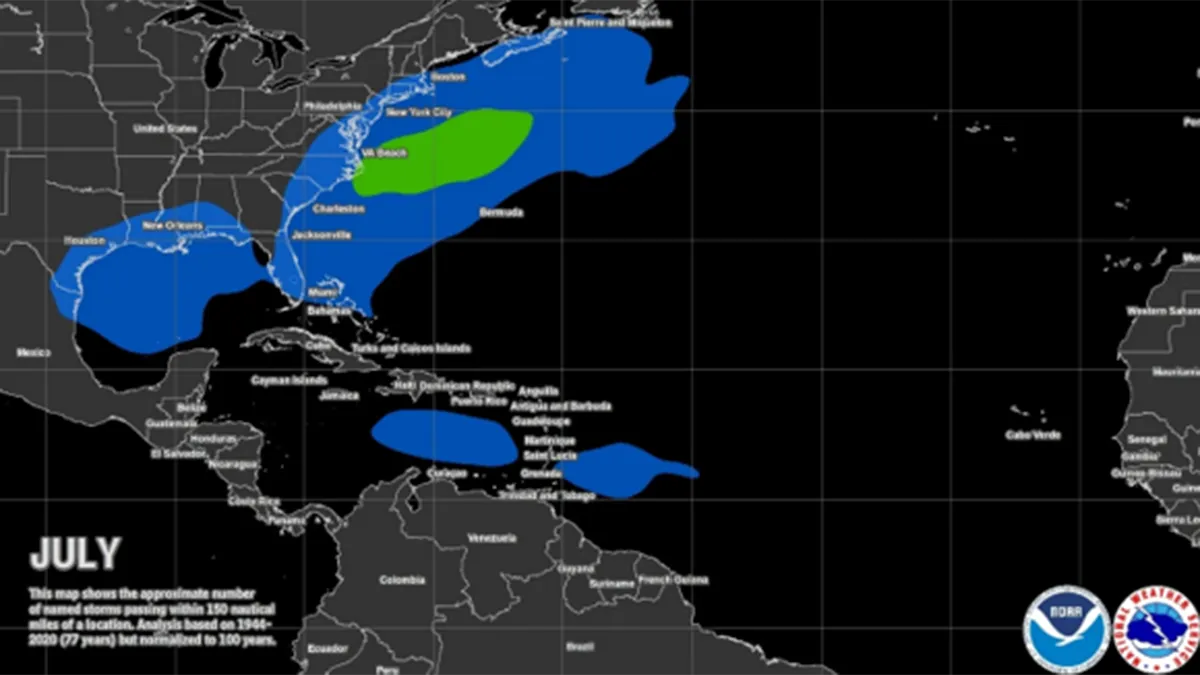
July is underway, and there is still no sign of life in the tropics. The outlook remains equally quiet over the next two weeks, with no development expected.
Read more Hialeah launches smart water meter pilot program to detect leaks, measure consumption
While July is typically one of the more muted months of the Atlantic hurricane season, that does not necessarily mean it’s uneventful.
Climatologically, the second named storm of the season usually forms during the middle to latter part of the month. In some years, however, activity accelerates quickly, moving beyond the “B” storm and well ahead of the seasonal average.
Even so, an early uptick in activity does not always translate into a dynamic hurricane season or significant impacts for South Florida.
A look back at the past decade, 2015 to 2025, illustrates just how variable July can be. Only one season, 2016, produced no named storms during the month, while several seasons had already reached the third or fourth named storm by month’s end.
The most remarkable example came in 2020, when the Atlantic produced the season’s fifth through eighth named storms before July concluded.
For South Florida, Tropical Storm Elsa in 2021 remains one of the more memorable July systems. Although the center passed well west of the region, wind gusts approached 70 mph in Key West. Elsa ultimately became the closest tropical cyclone to South Florida during the season, which finished with 21 named storms.
Despite remaining a tropical storm, Elsa required precautionary actions for commercial and recreational maritime interests, consistent with guidance issued by the National Weather Service in Key West.
In a more recent example, 2024’s Hurricane Beryl carved out its place in weather history by becoming the Atlantic Basin’s earliest Category 4 and Category 5 hurricane on record, intensifying rapidly after forming unusually far east near the Lesser Antilles. Beryl went on to produce significant impacts across portions of the Caribbean before moving into the Gulf of Mexico, making landfall along the Texas coastline.
Read more Man’s body found floating in Intracoastal Waterway in Hollywood, police say
Elsa and Beryl serve as reminders that impactful tropical cyclones can develop early in the season and track near populated areas.
Going back to climatology, July still favors development across the Gulf of Mexico and Mid-Atlantic, while gradually expanding into portions of the tropical Atlantic and Caribbean. Both Beryl and Elsa developed within or moved through these favored regions, drawing the attention of meteorologists, emergency managers, and coastal communities alike.
So far, 2026 has told a very different story. The Atlantic Basin remains quiet, as expected, and there is little indication that pattern will change anytime soon.
With El Niño taking hold in the Pacific and the lack of seedlings in favored development areas, it’s a challenging environment for systems to organize.
In addition, with doses of stabilizing Saharan air transiting the Atlantic and Caribbean, July does not appear poised to produce as past seasons have.
Even in an “off” year, there is still time to wait, watch and see. The best seasons are the slow years, but complacency should never accompany the quiet.
Review your hurricane plan with the NBC6 Hurricane Guide. It’s a free download you can find here.
Read more Man arrested after opening fire on Uber Eats driver in Miami-Dade, deputies say