
More than 100 bills are set to take effect in Florida on July 1, and while they range from administrative to obscure, some could affect your daily life.
Read more Driver, 17, killed in crash on I-95 at Hallandale Beach Boulevard in Broward
Here are 11 new laws you should know.
HB 35: Creates a “habitual traffic offender” designation (Isaiah’s Law)
Named for 18-year-old Isaiah Raposa, a motorcyclist who was killed in a hit-and-run crash in Gibsonton, Florida, HB 35 creates a designation for “habitual traffic offenders.”
This would include drivers with three or more convictions within a 5-year period for the following:
- failing to stop and render aid as required under Florida law in the event of a motor vehicle crash resulting in the death or personal injury of another.
- driving a commercial motor vehicle while his or her privilege is disqualified.
- driving a motor vehicle without a valid license.
Once a driver is officially designated as a habitual traffic offender, any subsequent driving offenses can be prosecuted as third-degree felonies.
HB 919: Renaming Palm Beach International Airport after President Donald Trump
This legislation dubs the West Palm Beach airport as “President Donald J. Trump International Airport.”
The law also prevents local governments from renaming several airports throughout the state, including Orlando International Airport, Miami International Airport, Fort Lauderdale/Hollywood International Airport, Tampa International Airport, Southwest Florida International Airport in Lee County and Jacksonville International Airport.
The name change is subject to approval by the Federal Aviation Administration and the execution of an agreement between Palm Beach County and the trademark holder authorizing the commercial use of the name Donald J. Trump International Airport.
HB 445: Revokes bond for convicts of dangerous crimes awaiting sentencing (Missy’s Law)
“Missy’s Law” was named after 5-year-old Missy Mogle, who was allegedly killed by her stepfather last year.
When signing the bill, Gov. Ron DeSantis said that Missy’s stepfather was convicted after he tried to meet a 15-year-old for sex, and while he was waiting for his sentencing, was let out on bond and killed Missy.
HB 445 would revoke bond for those convicted of dangerous crimes, which include arson, aggravated assault, child abuse, kidnapping sexual battery, robbery, carjacking, homicide, manslaughter
HB 33: Roads designated for Charlie Kirk, Donald Trump
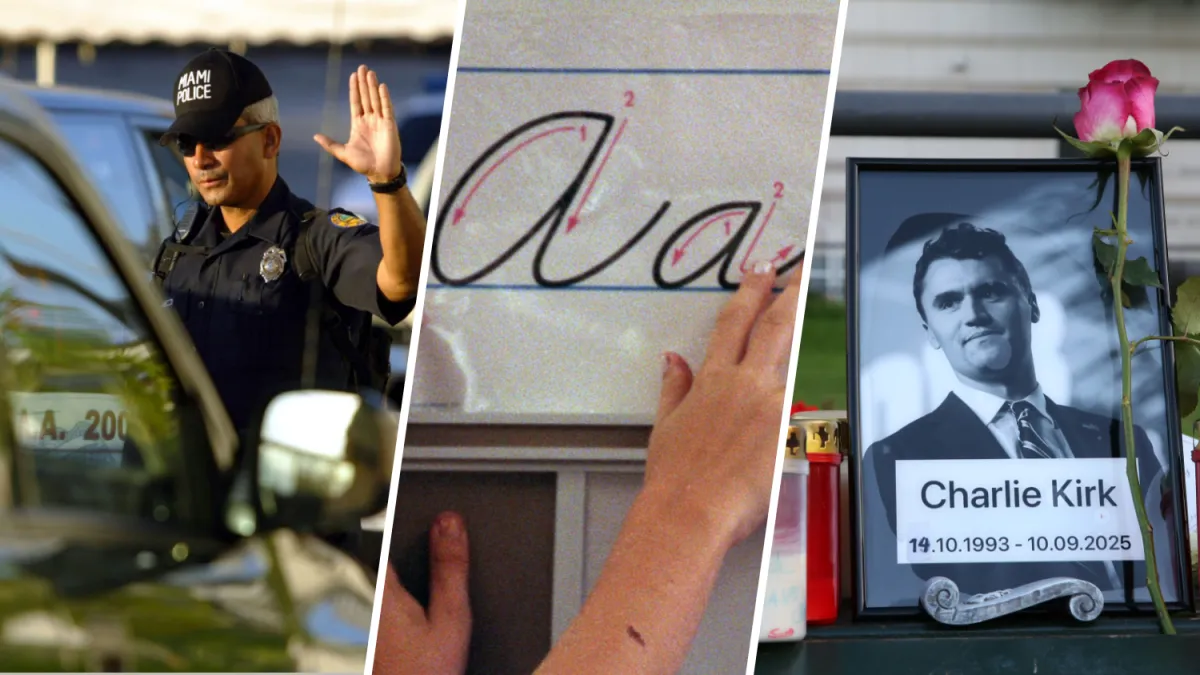
This bill would designate Southwest 107th Avenue between Southwest 24th Street and Southwest 8th Street in Miami-Dade County as “Charlie Kirk Memorial Avenue,” after the slain conservative activist.
It would also designate Commercial Boulevard within Lauderdale-by-the-Sea as “President Donald J. Trump Boulevard.”
HB 1279: Allows pay incentives for teachers at ‘D’ and ‘F’ schools
HB 1279 allows districts to provide immediate pay incentives to high-performing teachers who choose to teach in lower performing schools “without being burdened by collective bargaining,” the governor’s office announced.
It also “expands bonuses to teachers in Florida—ensuring that teachers delivering the Florida Advanced Courses are eligible for bonuses, just like those teaching Advanced Placement (AP) or International Baccalaureate (IB).”
The bill also makes several changes to Pre-K through college level education rules. Notably, it allows public postsecondary institutions to seek accreditation from accreditors beyond “regional” accreditors, and strikes references to the American Bar Association in statutes relating to the Florida A&M University College of Law and the Florida International University College of Law.
SB 182: Requires cursive writing education
Washington and Lincoln will soon be watching over Florida students as they practice their cursive.
Read more Man arrested after being accused of slapping park ranger in Fort Lauderdale, police say
A wide-ranging education bill (SB 182) includes provisions requiring students to learn cursive writing and for school districts to post pictures of Presidents George Washington and Abraham Lincoln at a “conspicuous place” in each public school.
Starting in third grade, students will learn to read and write in cursive and must be proficient by the fifth grade.
Cursive writing was previously required in Florida schools, but it was dropped in 2010 when the state adopted Common Core standards. The DOE reinstated it as a requirement in 2014 as an agency rule, but the new bill will cement the cursive standard in law.
For more on other provisions in the bill, go here.
HB 1159: Increases penalties for child sex-related crimes
HB 1159 enhances penalties and expands criminal offenses related to child sexual abuse material.
The legislation establishes mandatory minimum prison sentences for certain offenses committed by adults and creates a life felony for the aggravated exploitation of a child under the age of 12. It also “addresses emerging threats by criminalizing new forms of exploitation involving generated content,” DeSantis’ office said.
SB 484: Rules for data centers and the cost of their utilities
SB 484 aims to put restrictions on the growth of massive data centers that power the rapidly developing AI technology, and their affects on regional electric and water resources.
The bill prevents any increase in power costs associated with the data centers from being passed on to other customers.
“These are massive, massive centers,” DeSantis said in April. “The one that Meta wants to do in Louisiana is the size of Manhattan. And I think people look at that in Florida and they’re like, ‘is that we want our land gobbled up for, to be able to do that?’ We certainly are not going to allow them impose costs on Floridians.”
The bill also includes a requirement for the Office of Program Policy Analysis and Government Accountability to conduct an independent study on the economic impact of data centers, considering land, water, and energy uses and costs, along with affects on public health and safety.
But the measure allows local governments to keep confidential initial tech company plans for the centers for up to 12-months.
SB 428: Free swimming lesson voucher program expanded
SB 428 alters the eligibility requirement for the state Swimming Lesson Voucher Program from four years of age and younger to between the ages of one and seven.
HB 1217: Prohibits net-zero policies in local government
HB 1217 bans local governments from using net-zero policies to reduce greenhouse gas emissions or directing tax dollars for programs that advance net-zero policies.
HB 1201: Posters in schools to display seizure response protocol
This bill revises educational programs concerning epilepsy and revises requirements for a student’s individualized seizure action plan.
It specifies that each school must display a poster which describes the basic steps of responding to an individual having a seizure.
Read more Wife and children of Argentine soccer player Lucas Trejo killed in Venezuela earthquakes