
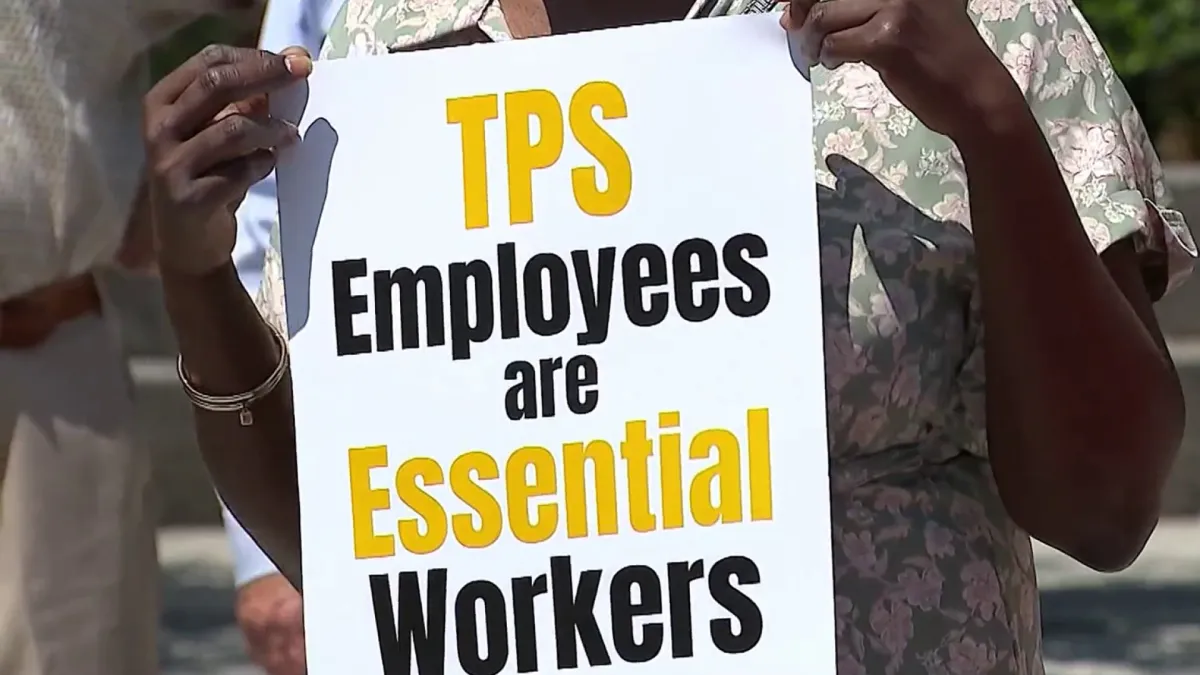
A federal judge is expected to formally lift protections for hundreds of thousands of Haitians after a Supreme Court ruling cleared the way for the Trump administration to end Temporary Protected Status. Advocates, attorneys and faith leaders are now looking to Congress for a possible path forward.
Read more ‘Bleeding to death’: 911 calls released after man fatally stabbed at Miramar gas station
As the clock runs out on Temporary Protected Status (TPS) for Haitians in the United States, a key legal step is expected to take place in federal court that could officially end protections for more than 300,000 people.
In June, the U.S. Supreme Court ruled 6-3 that President Donald Trump has the authority to terminate TPS for Haitians. The ruling affects hundreds of thousands of Haitian nationals who have been living and working legally in the United States under the humanitarian program.
According to appellate attorney Geoff Pipoly, lead counsel in the case before the Supreme Court, the legal process is now entering its final stage.
“The circuit court did not affirmatively extend TPS,” Pipoly said. “It simply denied the government’s motion to allow the Supreme Court’s judgment to take effect sooner than it ordinarily would have.”
Pipoly said the Supreme Court’s judgment ending TPS was set to take effect 32 days after the ruling, with the case now returning to U.S. District Judge Amy Berman Reyes.
“The next thing that happens is over the next 24 to 48 hours, it will go back ultimately to Judge Reyes, and Judge Reyes will enter an order lifting her February stay of TPS for Haiti, and then the termination
will be in full effect,” Pipoly said.
Meanwhile, NBC News has reported that Immigration and Customs Enforcement plans to increase arrests and deportations involving Haitian migrants as TPS protections come to an end.
That prospect has heightened anxiety throughout South Florida’s Haitian community, according to immigration attorney Frandley Julien.
“Everybody is in a state of uncertainty,” Julien said.
Julien said he has received reports that some TPS recipients have already been detained by ICE and that others are being referred to immigration court.
“We also have credible reports of numerous TPS recipients [who] have been issued notices to appear, so they’re being referred to the court system for removal proceedings,” Julien said.
Read more AMBER Alert issued for 13-year-old girl missing out of Ocala
Congressional effort offers hope
Despite the legal setbacks, supporters of TPS say there remains a potential political solution.
A bill currently before the Senate would extend TPS protections for Haitians. Earlier this year, the House passed similar legislation with bipartisan support, including votes from Republican lawmakers. All three Republican members of Congress representing South Florida supported the House measure.
Miami Archbishop Thomas Wenski said Congress remains the best avenue for relief.
Wenski is traveling to Washington, D.C., with other faith leaders in an effort to persuade senators to support extending TPS.
“A three-year extension is a temporary fix, but it buys time that will allow perhaps to avoid a massive and disruptive deportation,” Wenski said.
Concerns about conditions in Haiti
Advocates for extending TPS point to Haiti’s ongoing security crisis as a key reason protections should remain in place.
Much of the country continues to be affected by gang violence and political instability. The U.S. State Department currently maintains a Level 4 “Do Not Travel” advisory for Haiti, its highest warning level.
Wenski argued that humanitarian concerns should remain part of the debate.
“I tell people to make America great again is a lofty goal. It’s a lofty and praiseworthy goal,” Wenski said. “But you’re not going to make America great by making America mean.”
DHS defends TPS decision
In a statement Tuesday, a Department of Homeland Security spokesperson defended the administration’s position, saying TPS was never intended to be a permanent immigration status.
“Temporary Protected Status is exactly that, temporary,” the spokesperson said. “For too long, TPS has been allowed to function as a de facto amnesty program despite Congress never intending it to be permanent.”
With legal options dwindling, the fate of TPS for Haitians may now rest largely with Congress and whether lawmakers can advance legislation before protections formally expire.
Read more Pregnant woman attacked with machete after ex-boyfriend breaks into Miami home , police say