
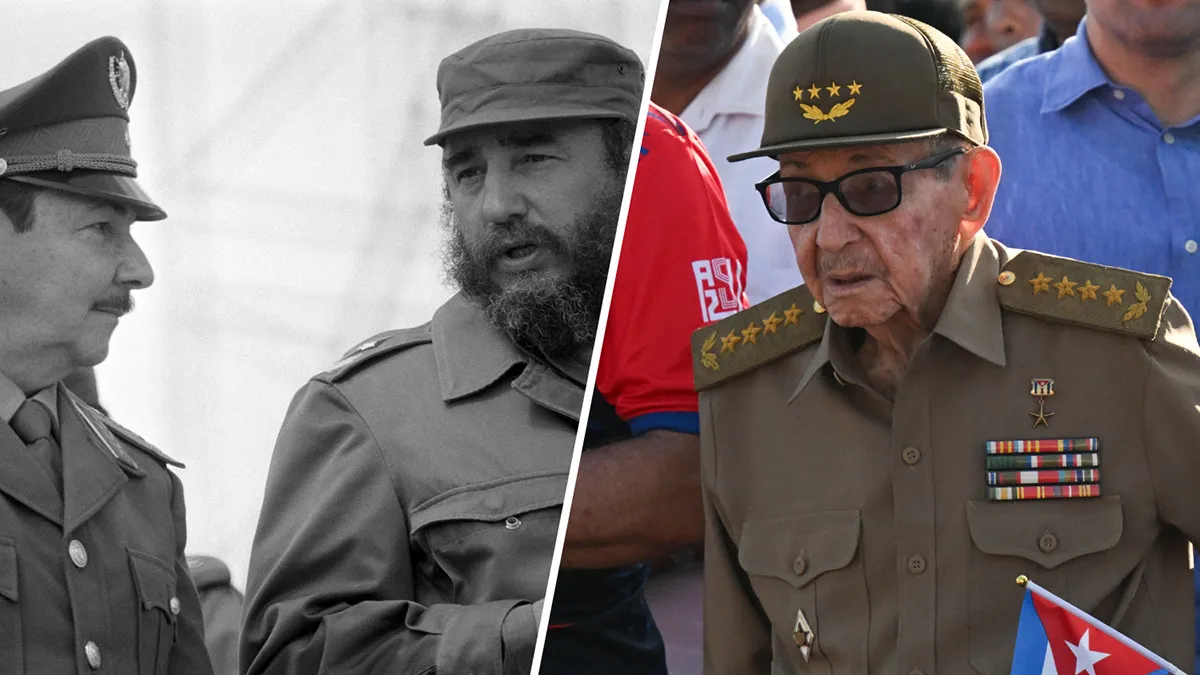
Former Cuban leader Raul Castro has been indicted by the United States in connection with his alleged role in the 1996 shootdown of two planes operated by the Miami-based exile group Brothers to the Rescue.
Read more Raul Castro indicted in Brothers to the Rescue shootdown: Here are the charges he faces
Wednesday’s unsealing of the indictment of the 94-year-old is just the latest twist in the life of a man who’s been in close proximity to or controlling the levers of power for the Communist country for more than six decades.
Who is Raul Castro?
The fourth of seven children of a Spanish immigrant in eastern Cuba, Raul had joined his charismatic older brother Fidel in a nearly suicidal attack on the Moncada military barracks in the eastern city of Santiago in 1953 and survived the crackdown that followed from the forces of dictator Fulgencio Batista.
Raul led a major front in the ensuing guerrilla war led by Fidel that toppled Batista in 1959.
Fidel formally became head of the party in 1965, about four years after officially embracing socialism and quickly absorbed the old party under his control and was the country’s unquestioned leader until falling ill in 2006.
For most of his life, Raul played second-string to his older brother Fidel — first as a guerrilla commander, later as a senior figure in their socialist government.
But in 2008, Fidel handed over the presidency to Raul, who succeeded him as head of the party in 2011. Fidel Castro died in 2016.
Raul quickly became the face of communist Cuba and its defiance of U.S. efforts to oust its socialist system.
For many years, he was considered a more orthodox communist than his brother.
But it was Raul who reached accords with U.S. President Barack Obama in 2014 that created the most extensive U.S. opening to Cuba since the early 1960s — creating a surge in contacts with the United States that was largely reversed under Obama’s successor, Donald Trump.
Raul handed power to a handpicked loyalist, Miguel Díaz-Canel, in 2018, and while he largely has avoided the spotlight since retiring in 2021 as head of the Cuban Communist Party, he is widely believed to wield power behind the scenes.
Florida straits shootdown a watershed moment in Cuba-U.S. relations
Cuba’s shootdown in 1996 of two Cessna aircraft operated by the Brothers to the Rescue was a watershed moment in decades of hostilities between the two countries.
Read more Shakira is seeking dancers to join her for the World Cup Final halftime show
Raul Castro was defense minister at the time and according to the indictment had authorized the use of deadly force against the Brothers to the Rescue.
At the time, President Bill Clinton had been cautiously exploring ways to reduce tensions with a Cold War adversary but faced stiff opposition from exiles who organized publicity-seeking flyovers of Havana, dropping anti-Castro leaflets, and aiding Cuban rafters fleeing economic deprivation and single-party rule.
The Cubans had warned the U.S. government for months that it was prepared to defend against what it considered deliberate provocations. But those calls went unheeded and on Feb. 24, 1996, missiles fired by Russian-made MiG-29 fighter jets downed two unarmed civilian Cessna planes just beyond Cuba’s airspace, according to an investigation conducted by the International Civil Aviation Organization. A third plane, carrying the organization’s leader, narrowly escaped.
“With hindsight, it appears the Castros’ motive was to slow down the Clinton outreach because they needed the U.S. as an external enemy to justify their national security posture,” said Richard Fienberg, who worked on Cuban issues at the National Security Council at the time.
They succeeded beyond their wildest dreams, said Feinberg.
Shortly after the shootdown, Congress passed what became known as the Helms-Burton Act, which codified a U.S. trade embargo enacted in 1962 and made it far more complicated for successive U.S. presidents to engage with Cuba.
To date, the U.S. has convicted only a single person of conspiracy to commit murder in connection with the Brothers to the Rescue shootdown. Gerardo Hernández, the leader of a Cuban espionage ring dismantled by the FBI in the 1990s, was sentenced to life in prison but was released by President Barack Obama during a prisoner swap in 2014 as part of an attempt to normalize relations with Cuba.
Two of the fighter jet pilots and their commanding officer were previously indicted but were outside the reach of U.S. law enforcement while living in Cuba.
Raul previously investigated for drug trafficking
Castro has been under U.S. criminal investigation before.
In 1993, federal prosecutors in Miami considered charging him and several other senior Cuban military officials with cocaine trafficking based on testimony from Colombian traffickers that emerged in the drug trial of former Panamanian leader Manuel Noriega, the AP reported in 2006.
But an indictment never followed amid concerns about the witness’ credibility as well as fears that it could risk U.S. intelligence operations and derail Clinton’s tentative outreach.
Read more Jan. 6 officers sue over $1.8B pot they call ‘slush fund’ for ‘insurrectionists’