
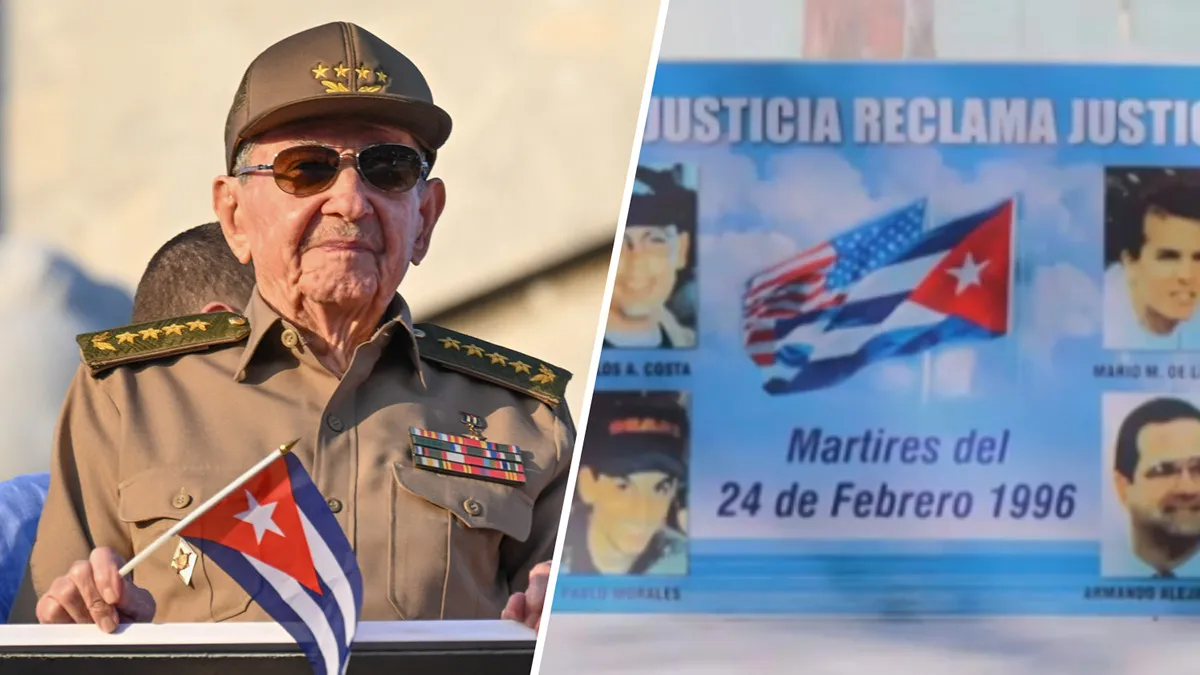
Former Cuban leader Raul Castro has been indicted by the United States for his alleged role in the 1996 downing of two planes operated by the Miami-based exile group Brothers to the Rescue.
Read more Shakira is seeking dancers to join her for the World Cup Final halftime show
The indictment unsealed Wednesday charges Castro and five others – Lorenzo Alberto Perez-Perez, Emilio Jose Palacio Blanco, Jose Fidel Gual Barzaga, Raul Simanca Cardenas, and Luis Raul Gonzalez-Pardo Rodriguez – with four counts of murder, two counts of destruction of aircraft, and conspiracy to kill U.S. nationals.
Castro, now 94, was Cuba’s defense minister at the time of the shootdown. The five others charged were pilots allegedly involved in the operation.
Indictment details charges against six defendants
According to the indictment, Raul Castro had authorized the use of deadly force against the Brothers to the Rescue.
Perez-Perez was operating the fighter jet that used air-to-air missiles to shoot down the two planes, which were flying outside of Cuban territory, the indictment said.
Barzaga, Cardenas and Rodriguez followed a third Brothers to the Rescue plane that escaped destruction, the indictment said.
“It was the object of the conspiracy to kill U.S. nationals by shooting down BTTR aircraft, using information provided by spies in Miami, to terrorize, intimidate and retaliate against the Cuban people and the Cuban exile community,” the indictment said.
Where is Raul Castro now?
There’s no indication Castro will be taken into U.S. custody anytime soon.
He took over as president from his ailing older brother Fidel Castro in 2006 before handing power to a trusted loyalist, Miguel Díaz-Canel, in 2018.
While he retired in 2021 as head of the Cuban Communist Party, he is widely believed to wield power behind the scenes, underscored by the prominence of his grandson, Raúl Guillermo Rodríguez Castro, who previously met secretly with Secretary of State Marco Rubio.
The investigation into Castro stretches back to the 1990s
Starting in 1995, planes flown by members of Brothers to the Rescue, a group founded by Cuban exiles, buzzed over Havana dropping leaflets urging Cubans to rise up against the Castro government.
Read more Jan. 6 officers sue over $1.8B pot they call ‘slush fund’ for ‘insurrectionists’
The Cubans protested to the U.S. government, warning that they would defend their airspace. Federal Aviation Administration officials also opened an investigation and met with the group’s leaders to urge them to ground the flights, according to declassified government records obtained by George Washington University’s National Security Archive.
“This latest overflight can only be seen as further taunting of the Cuban Government,” an FAA official wrote in an email to her superiors after one intrusion in January 1996. “Worst case scenario is that one of these days the Cubans will shoot down one of these planes.”
But those calls went unheeded and on Feb. 24, 1996, missiles fired by Russian-made MiG-29 fighter jets downed two unarmed civilian Cessna planes a short distance north of Havana just beyond Cuba’s airspace. All four men aboard – Carlos Costa, Armando Alejandro Jr., Mario de la Peña, and Pablo Morales – were killed.
Raúl Castro faced earlier indictment
Guy Lewis, who was a federal prosecutor, uncovered evidence linking senior Cuban military officials to cocaine trafficking by Colombia’s Medellin cartel. Following the shootdown, the investigation expanded, and prosecutors pursued charges against Raúl Castro for leading a vast racketeering conspiracy by Cuba’s armed forces.
“The evidence was strong,” Lewis said in an interview.
In the end, the Clinton administration indicted four individuals, including the MiG pilots, the head of the Cuban air force and the head of a Cuban spy network in Miami — the only one to see the inside of a U.S. prison — for providing valuable intelligence about the flights.
The incident led the U.S. to harden its position against Cuba, even though the Cold War had ended and the Castros’ support for revolution across Latin America was a fading memory.
But Castro himself was spared as the Clinton administration — which had quietly sought to expand relations with Cuba prior to the incident — raised foreign policy concerns about such a high-profile indictment.
“Raúl was definitely one who slipped through the noose,” Lewis said. “The crime is notorious. Three U.S. citizens and one legal permanent resident were killed in a premeditated orchestrated murder. That should never be forgotten.”
Read more Miami man arrested for coordinating multiple intersection takeovers, deputies say