
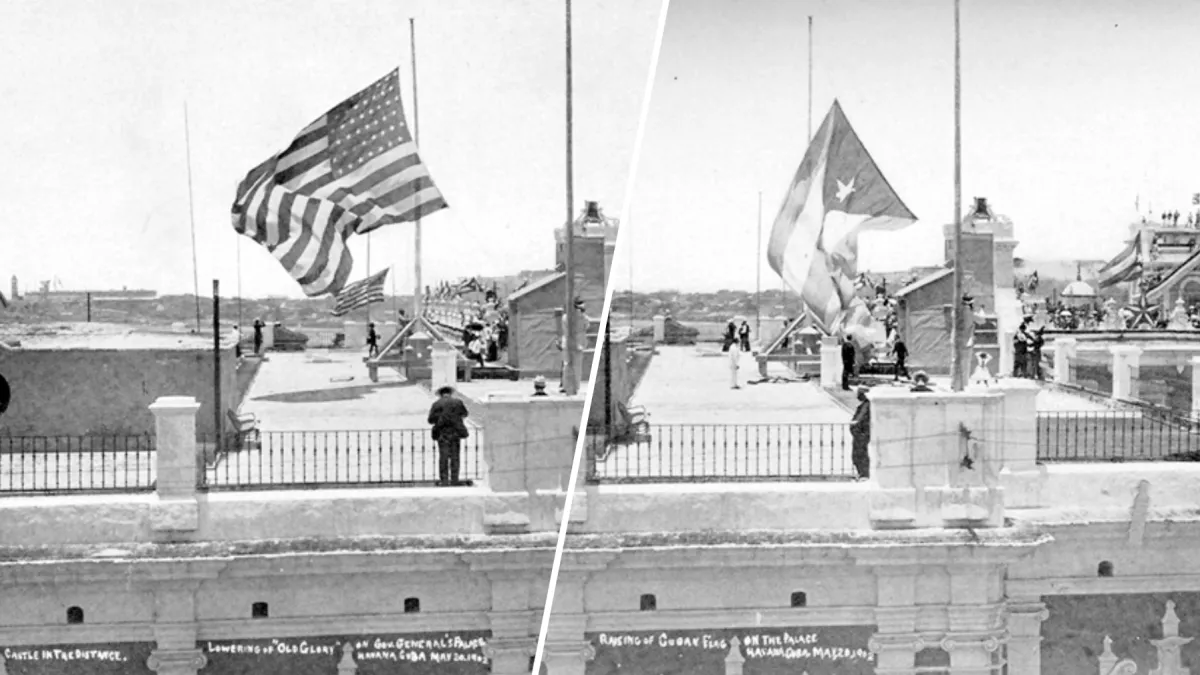
May 20, 1902, is recognized as the official birth of the Republic of Cuba after centuries of Spanish rule (1511–1898) and a U.S. military occupation (1899–1902) that paved the way for its transition to a sovereign state.
Read more Mom speaks after daughter sexually battered by guardian at juvenile justice facility, BSO says
That day, the Cuban flag flew on its own—without the U.S. flag alongside it—as had been the case up to that point after Spain’s withdrawal.
In this way, buildings such as El Morro Castle, the fortress guarding Havana Bay, or the Palace of the Captains General, the center of Spanish political power on the island, witnessed the birth of a free Cuba.
Erasing May 20
However, the close ties between Cuba and the U.S. government—and the agreements that allowed Washington to intervene in the country—led to the history of the date being censored starting in 1959, with Fidel Castro’s arrival.
The message from the newly formed communist government was that freedom had arrived with them on January 1 of that year, and that the previous period had been a form of colonization, similar to what Cuba had lived under Spanish rule.
They argued that the Platt Amendment, an annex to the 1902 Constitution, undermined Cuba’s independence and meant that the very birth of the Republic had been incomplete.
Read more Live updates: Today’s South Florida News
Any celebration of May 20 was meant to be erased, and the significance of the date was persecuted by the regime. But over the years, as opposition grew inside Cuba and also as part of exile tradition, the date was not lost to history—and instead began to gain visibility both on and off the island.
It’s even leaked into Cuban vernacular, with the expression: “You’re going to get yourself a May 20,” a reference to ending up in a tense, conflict-filled situation.
Reactions from the United States
For years, U.S. presidents and other politicians have used the date to congratulate Cubans and to remind them of the island’s fight for freedom.
Secretary of State Marco Rubio, along with South Florida members of Congress of Cuban descent such as Mario Díaz-Balart, María Elvira Salazar, and Carlos Giménez, have highlighted the date and its impact on the exile community.
Trump already congratulated the island nation during his first term (2017–2021) in connection with that independence—something his predecessor at the time, Barack Obama (2009–2017), did not do during his presidency—but other leaders did, including George W. Bush (2001–2009), Bill Clinton (1993–2001), and George H. W. Bush (1989–1993).
Read more Police SUV involved in violent crash that downed palm tree in Hollywood