
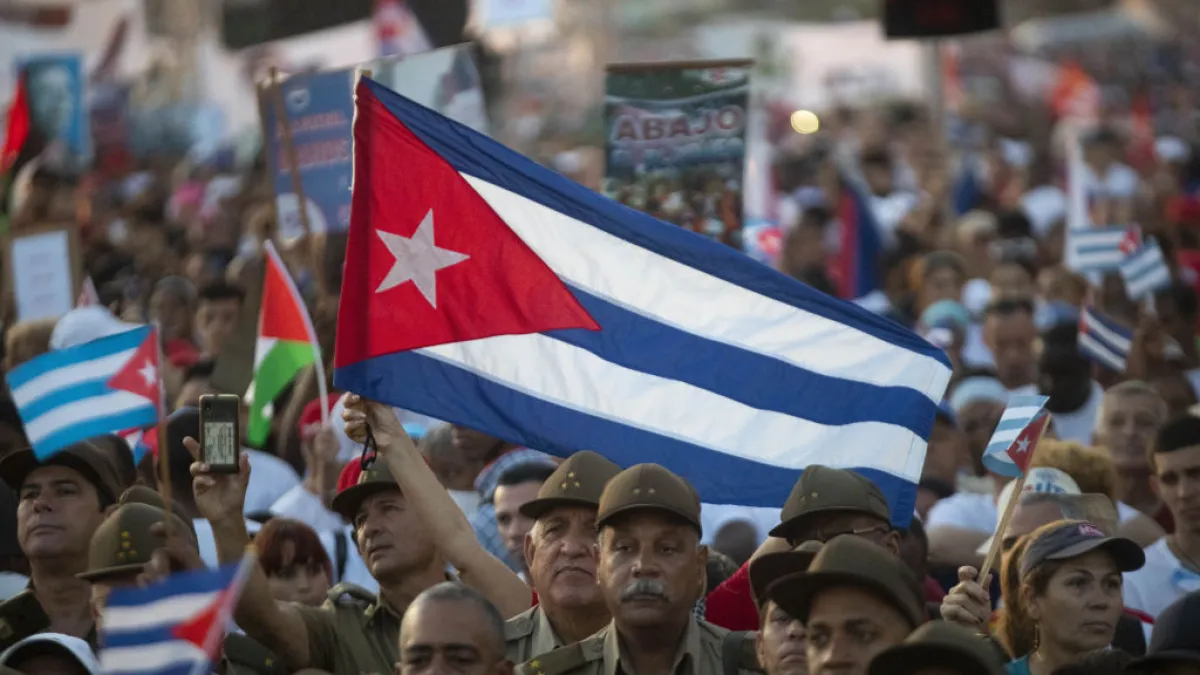
A newly released State Department report argues that Cuba’s influence extends far beyond the island’s borders, portraying Havana as the center of a decades-long network of political, intelligence, and ideological activity that has shaped events across Latin America and reached into the United States.
Read more All About Animals
The nearly 100-page report contends that Cuba’s significance is not rooted in its economy or military power, but in its ability to build and sustain alliances, influence movements, and cultivate networks that have persisted across generations.
The report, titled Cuba: The Capital of 21st Century Communism, was released as the Trump administration intensifies scrutiny of Cuba’s role in the hemisphere and follows remarks by Secretary of State Marco Rubio at last week’s Ministerial on the Resurgence of Political Terrorism.
Rubio cited Cuba repeatedly during his speech, arguing that Havana has played a central role in supporting revolutionary movements and left-wing political networks.
Rubio: Cuba Built a Hemisphere-Wide Network
Speaking at the State Department on July 16, Rubio pointed to Cuba’s historical involvement in revolutionary movements throughout Latin America.
“You remember the tens of thousands of Marxist guerrillas trained to kill in Castro’s terrorist camps,” Rubio said.
Later in the speech, Rubio connected those historical efforts to present-day politics.
“The Cuban regime’s sprawling intelligence and ideological network helped to build the far-left in our country and in our hemisphere, and it remains inextricably linked to the far-left groups and movements across and beyond the West,” Rubio said.
His comments closely mirror the report’s central thesis: that Cuba has spent decades exporting influence through revolutionary movements, intelligence activities, activist networks, educational exchanges, and political alliances.
Nicaragua and Venezuela Highlighted as Key Examples
Among the report’s most significant claims are its descriptions of Cuba’s relationship with Nicaragua and Venezuela, which it identifies as two of Havana’s greatest geopolitical successes.
The report characterizes the Sandinista Revolution in Nicaragua as one of Cuba’s most consequential victories. According to the document, Cuba provided arms, training, logistical support, and political coordination to the Sandinista National Liberation Front (FSLN), which overthrew the Somoza government in 1979. The report argues Havana became an operational hub for the movement, helping unite factions and coordinate support throughout the region.
The report identifies Venezuela as a more modern example of Cuban influence. It argues that after Hugo Chávez came to power in 1999, Cuba transitioned from supporting armed insurgencies to working through allied governments.
The report claims thousands of Cuban personnel were integrated into Venezuelan government institutions, social programs, security agencies, and intelligence operations in exchange for heavily subsidized oil.
According to the report, Cuba helped Venezuela develop internal security and intelligence structures while expanding its own influence within the country. The document describes Venezuela as becoming “a second revolutionary capital” operating alongside Havana.
Focus on Espionage
A significant portion of the report is dedicated to Cuban intelligence activities and espionage operations targeting the United States. The report details several well-known cases involving individuals who were convicted of spying for Cuba, including former U.S. ambassador Victor Manuel Rocha, Defense Intelligence Agency analyst Ana Montes, and members of the so-called Wasp Network.
The authors argue that Cuban intelligence agencies have historically relied on ideological recruitment rather than financial incentives and have focused on long-term access to government institutions, universities, and political networks.
Read more Man arrested after girl shared his THC gummies at Plantation camp, cops say
The report echoes concerns long expressed by U.S. counterintelligence officials. One example cited is former CIA counterintelligence chief James Olson, who described Cuban intelligence as among the most formidable adversaries the United States has faced.
The FBI has also publicly highlighted Cuba’s intelligence capabilities.
In a recent FBI counterintelligence segment, a former official stated:
“The bottom line is Cuba has punched well above their weight for a long time. For such a small island, they have really been a thorn in our side because they’re really good at what they do.”
U.S.-Based Groups Examined
The report devotes multiple chapters to organizations it says have played a role in developing or maintaining ties between American activists and the Cuban government.
The report also repeatedly references ICAP, the Cuban Institute of Friendship with the Peoples, which it describes as the central organization coordinating many exchanges, delegations, and solidarity programs connecting Cuba with activists and organizations in the United States.
The document argues that these organizations helped create and sustain relationships between American political movements and Cuban institutions, though the nature of those relationships varies significantly from group to group.
Cuban Exile Reaction
For some Cuban exile activists, the report reinforces longstanding concerns about Cuba’s influence beyond the island.
Orlando Gutiérrez, who is part of the Assembly of the Cuban Resistance, said the report validates warnings Cuban exiles have made for decades.
“I think that the information contained shows why this regime in Cuba is a threat to the entire hemisphere, to the U.S., how it’s been consistently behind efforts to subvert American democracy, American politics,” Gutiérrez said.
The report itself states that:
“The Cubans perfected a new model for a long war of attrition, organized around espionage, infiltration, sabotage, proxy networks, and a revolutionary infrastructure designed to turn America against itself.”
Critics Question Report’s Objectivity
Not everyone is expected to accept the report’s conclusions without scrutiny.
NBC6 Political Analyst Alex Penelas noted that the report was produced by the State Department and not by an independent academic institution or outside commission.
“Clearly there will be some who will question the legitimacy of this report because it comes directly from the President’s Department of State and not from an independent agency,” Penelas said.
Still, Penelas said the report is likely to strengthen arguments among policymakers who favor maintaining pressure on the Cuban government and pursuing political change on the island.
Cuba Pushes Back
The Cuban government has rejected Rubio’s characterization of Cuba’s role in the hemisphere.
Following Rubio’s remarks, Cuban Foreign Minister Bruno Rodríguez accused the secretary of state of ignoring activity by anti-Castro groups operating in the United States.
Rodríguez wrote that Rubio, “deliberately overlooks the protection granted on U.S. soil to those who finance, organize, incite, and train for terrorist acts against Cuba, primarily in the State of Florida—coincidentally, his home state.”
Read more Miami Police lieutenant arrested on DUI charge after crash, cops say