
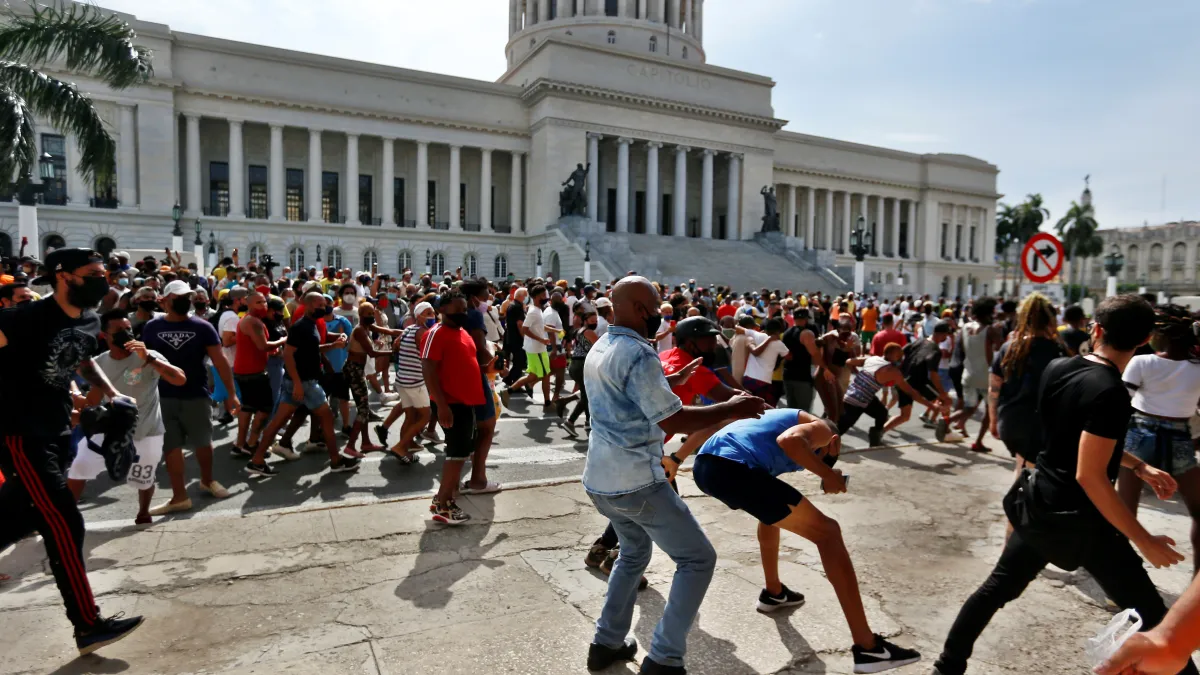
Five years ago, protests quickly spread across dozens of Cuban cities, driven by a combination of factors: blackouts, shortages of food and medicine, the impact of the pandemic, the economic crisis, and growing dissatisfaction with the country’s political situation.
Read more Catch a python? This Florida restaurant will accept it as currency
The images on July 11, 2021, went around the world within hours.
Thousands of people marched shouting “Freedom” and “Homeland and Life,” while social media streamed in real time what was happening on an island that for decades had seen very few public displays of opposition on that scale.
The state’s response was immediate. Then-leader Miguel Díaz-Canel’s call for government supporters to take to the streets was followed by a broad deployment of police and security forces that led to mass arrests, clashes, and court cases that would shape the years that followed.
The judicial legacy of 11J
Five years later, one of the main consequences of those days remains the situation of the people prosecuted for taking part in the demonstrations.
International human rights organizations say that hundreds of people remain behind bars on charges linked to 11J.
Amnesty International says people are still imprisoned for exercising rights such as freedom of expression and peaceful assembly, while alleging that several proceedings were marked by harsh sentences and the use of criminal charges such as sedition, sabotage, assault, or public disorder.
For their part, Cuban authorities have repeatedly defended the courts’ actions and argue that those punished were tried for crimes provided for under national law, not for their political views.
In April of this year, the government announced the pardon of more than 2,000 inmates for humanitarian reasons. However, organizations such as Amnesty International noted that the measure did not clarify how many political prisoners benefited and called for greater transparency about the releases.
Protest stopped being an exceptional event
Beyond the events of July 2021, specialists believe 11J changed the country’s social dynamics.
Cuban sociologist Cecilia Bobes argues that protests stopped being isolated episodes and became a recurring way for citizens to express discontent.
According to her research, in 2026, hundreds of protest actions have been recorded, mainly tied to prolonged blackouts, lack of food, the deterioration of public services, and government economic decisions.
Demonstrations have also evolved. Alongside the traditional demands for better living conditions, political slogans are appearing more and more often, while social media continues to play a key role in documenting and spreading what happens.
Read more Massive trees falls, crushes car in Hollywood after overnight storm
A new generation of critical voices
Another significant shift has been the profile of those who today face court proceedings or state surveillance.
Researchers and human rights groups point to the growing prominence of young content creators, independent journalists, and active social media users who use digital platforms to call out everyday problems or criticize the government.
This marks a change from previous decades, when the face of dissent was mainly associated with traditional activists and opposition figures.
A crisis that keeps fueling discontent
Five years after 11J, Cuba is still going through a complex economic crisis marked by inflation, blackouts, shortages of food, medicine, and fuel, as well as the exodus of hundreds of thousands of citizens in recent years.
Analysts agree these problems keep social unrest alive, though they also point out that factors such as repression, fear of new sentences, and mass emigration make it difficult to organize mobilizations on the scale seen in 2021.
An anniversary that keeps the debate alive
The fifth anniversary of 11J arrives in a very different context than five years ago, but with questions that remain unresolved.
International organizations continue to call for the release of those they consider political prisoners and for stronger guarantees for the exercise of fundamental freedoms.
Five years later, July 11 remains one of the most consequential events in Cuba’s recent history. For some, it symbolizes the awakening of citizens who chose to express their dissatisfaction publicly; for others, an episode that tested the country’s stability.
What seems indisputable is that that day transformed the relationship between Cuban society, institutions, and public space. Its impact is still felt in the streets, on social media, in the courts, and in the collective memory of an island that continues to face enormous economic, social, and political challenges.
This story was translated from Spanish with the help of a generative artificial intelligence tool. An NBC digital editor reviewed the translation.