
As the climate heats up, South Florida’s coral reefs are feeling it.
Three summers ago, excessively high water temperatures, combined with a disease, killed many of the hard corals on the Florida Keys reef tract. Fearing a repeat is on the way, University of Miami researchers dove into action on Wednesday.
Read more The battle for Florida’s 24th District: Candidates face off in debate at Little Haiti public forum
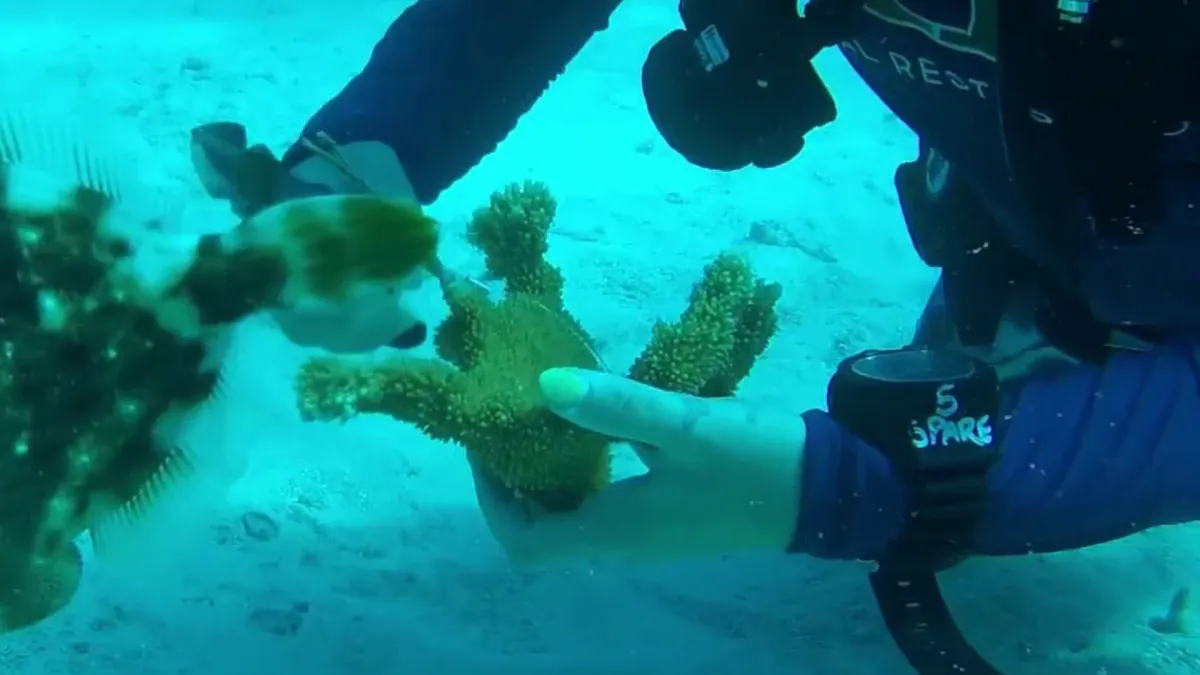
A team of divers removed elkhorn corals from their offshore nurseries, packed them into a cooler, and headed for shore. The cooler contained some of the last surviving strands of the species, a sort of Noah’s ark of Florida elkhorn.
“So these are the last remaining pieces of this species, you know we talk about species extinction and a lot of times it seems so distant, but it’s right here in front of us,” said Dalton Hesley, a coral expert with the Rosenstiel School of Marine, Atmospheric and Earth Science at the University of Miami.
UM researchers moved dozens of corals from their nursery sites to holding tanks on land. The 2023 heat wave wiped out 90% of the elkhorn and staghorn corals in Florida.
“Today was lessons learned, many of you remember the 2023 bleaching event where there was devastating loss of coral species and we recognized that we have to be more proactive because this would happen again,” Hesley explained.
Moving the corals to holding tanks is a stopgap effort. The plan is to keep them in the tanks until the ocean cools off in the fall, and then bring them back out to the offshore nurseries. They left some of the elkhorn in the offshore nurseries to see how they fare.
Read more South Florida veterinarian operated on dog’s wrong leg, lawsuit says
“It may look small scale, a lot of hands on a few corals, but it’s critically important because we are trying to preserve the last few remaining founders of this species that is critically endangered everywhere in its domain and functionally extinct in Florida,” said Diego Lirman, a senior researcher at Rosenstiel.
Functionally extinct means they can’t reproduce enough to recover on their own in the wild. Last year, another team of researchers from UM planted hybrid elkhorn corals, a mix of Florida and Honduran species, on a reef off Key Biscayne. The Honduran elkhorn have withstood high water temperatures and pollution in their native waters, so there are high hopes that mixing them with Florida elkhorn will inject new life into the reefscape. The results of that experiment are still being evaluated.
Wednesday’s effort involved 30 genotypes of the same species of coral, originally harvested from the waters of Broward County all the way through the Lower Keys.
“So these are the last of the wild populations that we know in South Florida, meaning that we collected small pieces years back, and maintained them and gardened them but their parents, the ones we initially collected from, are likely gone,” Hesley said.
The researchers are hoping corals that survive will be tougher, more resilient, and able to handle the warming seas. The ultimate goal is to plant enough of them on the reefs to create a self-sustaining population, bringing the elkhorn back from the brink.
Read more South Florida pharmacist convicted of illegally distributing 300,000 oxycodone pills