
The presence of U.S. military aircraft off Cuba’s coast is once again back at the center of international attention.
Read more Man in critical condition after being stabbed in Miami-Dade County, deputies say
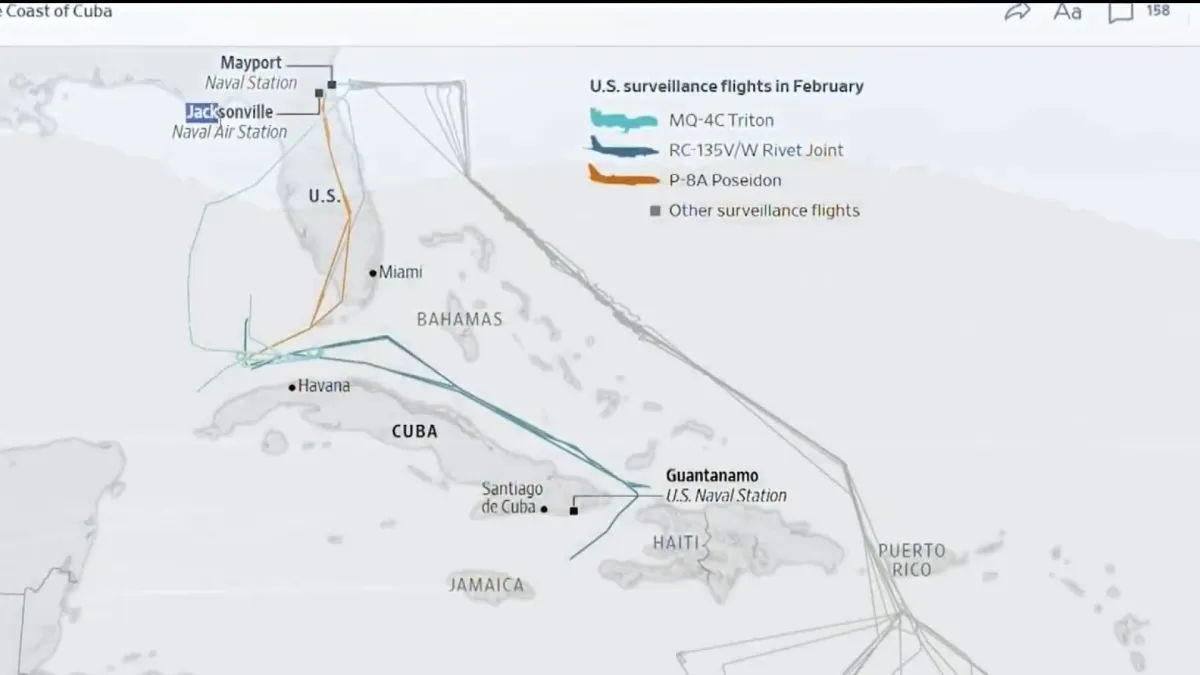
According to a report published by The Wall Street Journal, the United States has logged more than 150 hours of surveillance and intelligence flights around Cuba since February of this year.
The report documents more than 20 missions carried out mainly by reconnaissance aircraft such as the RC-135 Rivet Joint, the P-8 Poseidon and the MQ-4C Triton drone, operating over international waters and at times coming within about 30 miles of the island, especially near Havana and Santiago de Cuba.
According to experts consulted by NBC6 sister station Telemundo 51, these platforms make it possible to gather information on radar systems, air defenses, communications and Cuban military movements: “an X-ray from the air of the regime’s military capabilities,” explained Octavio Pérez, a retired lieutenant colonel in the U.S. Army.
“It’s used to capture information: how they operate, which radars come online first, the anti-aircraft battery systems … all of this is picked up with these platforms,” Pérez said.
While these types of flights are not new, analysts believe the recent increase carries political and strategic weight.
The Wall Street Journal itself notes that Washington has allowed many of these aircraft to publicly broadcast their position through transponders—something unusual for sensitive operations.
Pérez believes the uptick in activity sends two signals.
“This is the norm when you’re preparing for some kind of military action, but it’s also sending a message,” he said. “We’re ready, we have what we need, and we’re ready to act.”
Read more Massive junkyard fire prompts evacuations, spreads to businesses in Opa-locka
The operations come amid a sharp political escalation between Washington and Havana, marked by new sanctions from the Trump administration, accusations of murder against Raúl Castro, and growing intelligence concerns about the presence of Chinese and Russian facilities in Cuba.
Meanwhile, Cuba’s Civil Aeronautics Institute published a message this weekend reminding that “each State has complete and exclusive sovereignty over its airspace,” citing articles of the Chicago Convention on international civil aviation.
Although the statement does not directly mention the United States, it comes precisely as reports of military overflights and monitoring in the Caribbean increase.
In Cuba, while state television continues airing images of military drills and defensive preparations, many citizens seem more concerned about the economic crisis than about a possible military confrontation.
“Nobody talks about that,” said a traveler who recently arrived in Miami. “They’re only worried about what to put on the table. It’s sad, but it’s the reality.”
This story was translated from English with the help of a generative AI tool. An NBC6 editor reviewed the translation.
Read more Live updates: Today’s South Florida News