
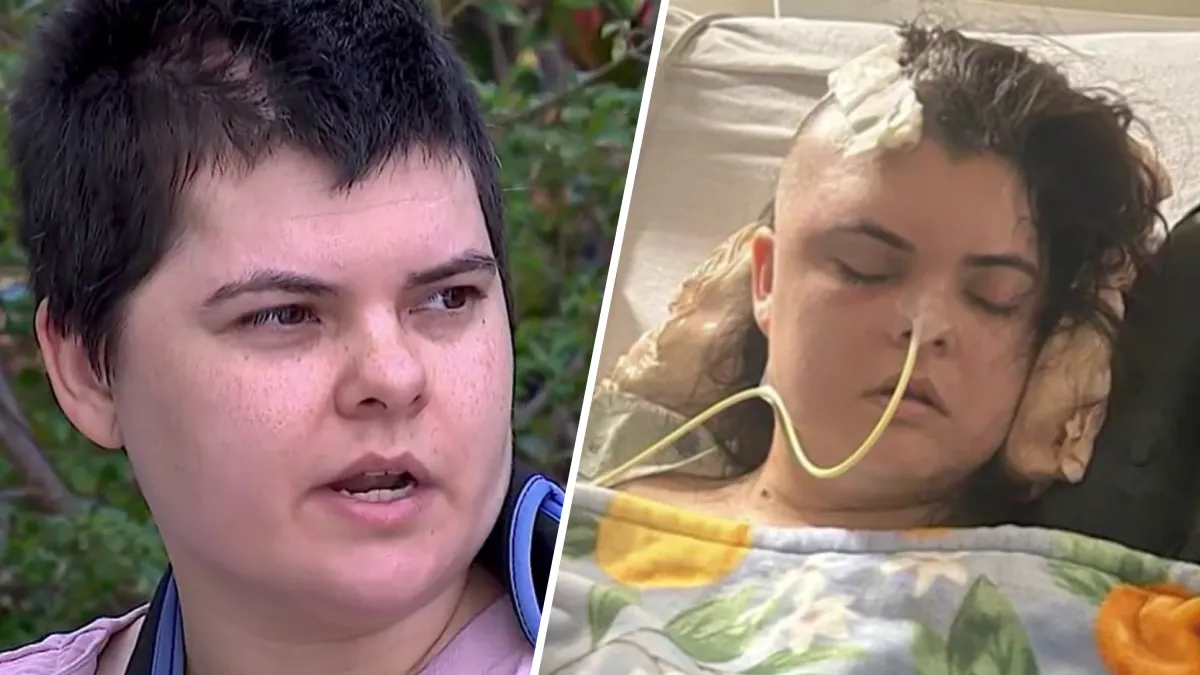
A South Florida woman was driving for Uber when she suddenly began to lose feeling in half her body.
Read more Miami teen awarded $6k scholarship after saving neighbor from fire
Her arm went numb, her face started to droop, and in that moment, she turned to ChatGPT for answers. What it told her likely saved her life.
“They told me if you had taken longer to call, you could have passed out in the car, bled out and died, so that saved my life,” 30‑year‑old stroke survivor Diana Hurtado told NBC6.
A stroke was the last thing Diana expected at her age. As the symptoms came on while she was driving, she opened ChatGPT.
“I asked ChatGPT what it could be, and I wrote all the symptoms that I was feeling,” she said. “It told me, ‘possible stroke – call 911,’ so that’s when I told Siri to call 911.”
With her body shutting down, technology filled the gap. Diana drove herself to Broward Health North’s emergency room, where doctors confirmed she was having a stroke caused by a genetic mutation that leads to blood clots.
“She got very, very lucky, really, in many ways,” said Dr. Shaye Moskowitz, her neurosurgeon at Broward Health. “The extent of damage that can occur from a stroke can be profound. It can be life-ending, and it often is.”
A stroke happens when blood flow to the brain is blocked or when a blood vessel bursts. According to the American Heart Association, it is the No. 1 reason people in the United States are left with long‑term disabilities.
For Diana, recovery has been intense. She continues therapy, relearning how to walk, regaining mobility in her arm, and healing from brain surgery where doctors had to remove part of her skull to relieve pressure.
Read more Graphic designer accused of creating and posting altered sexual images
But the emotional and psychological aspects of recovery have been the hardest, Diana said.
She is working on healing that, too, by serving others again through mission work in Costa Rica. Now her mission goes even further.
“I was only 30 years old, and like me, many people think that stroke is for old people,” she said. “You do not recognize the symptoms because you have never heard of it, or you do not even think you can get it because you are young.”
Dr. Moskowitz says seeing someone of Diana’s age with a stroke is still uncommon, but it is happening more often.
“It is not common,” he said. “It is becoming progressively, unfortunately, more common globally that younger people are having strokes.”
Strokes can be caused by a range of factors, from high blood pressure to genetics, as in Diana’s case. She is now on medication to prevent another one. Life looks different for her now. She moves more slowly but with a new outlook. Simple things like eating and talking feel like milestones.
If there is one thing Diana and her doctors want people to remember, it is the acronym BE FAST.
Read more Heavy smoke seen on Max Road in Broward after wildfire breaks out
- Balance: sudden loss of balance or coordination
- Eyes: sudden trouble seeing in one or both eyes
- Face: face drooping on one side
- Arm: weakness or numbness in one arm
- Speech: slurred speech or difficulty speaking
- Time: time to call 911 immediately
Recognizing these signs quickly and acting fast can save a life.