
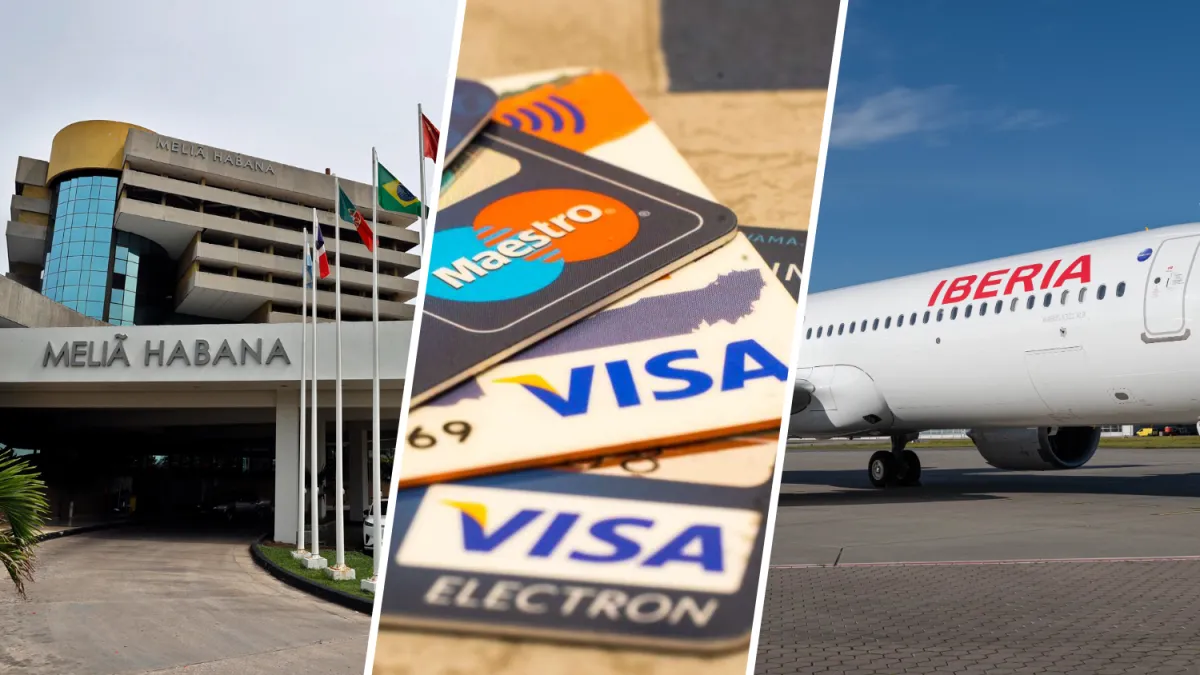
The Central Bank of Cuba reported this Wednesday that transactions with Visa and Mastercard will be suspended starting June 6, after a foreign partner decided to stop processing them due to the impact of United States sanctions.
Read more Miami-Dade shuts down alleged illegal post-op recovery home, leaving patients searching for care
The private bank that handled overseas operations informed the monetary authority that it was ending its relationship with the financial entity Fincimex, which belongs to the Gaesa business conglomerate, in order to avoid sanctions.
The departure of this bank means cutting off all of the island’s financial connections with the outside world, increasing Washington’s pressure on Cuba, which the U.S. government wants to push into adopting sweeping political and economic reforms.
Adding to the impact of this measure is the partial exit from Cuba of Spanish hotel company Meliá, the largest foreign operator in the sector. It is the fourth announcement of this kind in barely a week, following decisions by Spain’s Iberostar, Canada’s Blue Diamond, and Indonesia’s Archipelago International.
These developments — which carry economic consequences for both the chains and Cuba — are directly linked to the U.S. Executive Order of May 1, which provided for sanctions against individuals and companies conducting business with the Cuban state, as well as the sanction imposed a week later on the Revolutionary Armed Forces (FAR) conglomerate, Gaesa.
Meliá announced that it will stop operating and marketing “immediately” 15 of the 35 hotels it oversees in Cuba—all properties on the island are state-owned, but many are managed by international chains—citing “new circumstances beyond its control” linked to the “geopolitical, social, legal, and economic context.”
The decision was made “out of a deep sense of corporate responsibility, and is the response to — and consequence of — a combination of new circumstances beyond Ilha Bela’s ability to manage or act.”
This comes just a day after it emerged that Archipelago International, responsible for recent high-profile projects such as the Grand Aston on Havana’s Malecón, was leaving the management of the six hotels it operates.
On Tuesday, Iberostar — the second-largest foreign hotel operator in Cuba — decided to stop operating and marketing properties on the island. In its announcement, it said it had decided to keep only 6 of the 18 properties it had been managing. The chain stopped managing, marketing, and promoting flagship hotels such as the Selection La Habana and the Grand Packard.
Iberostar pointed to the need to “adapt to the international regulatory environment” and explained that it was leaving facilities owned by Gaviota, Gaesa’s tourism company, but would remain in charge of those owned by Cubanacán and Caribe, both companies under the Ministry of Tourism.
The first chain to make a decision was Canada’s Blue Diamond—the third-largest foreign hotel chain in Cuba by number of properties managed—which will fully cease its operations on the island. It operated around fifteen hotels in Cuba, mainly in Havana and in Cayo Largo del Sur. Like Archipelago International, it decided to leave the island entirely.
At the same time, Spanish airline Iberia has suspended its operations on the Madrid–Havana route.
Canadian mining company Sherritt, the largest foreign investment in Cuba, announced a month ago that it would immediately exit the island in response to US sanctions.
Read more World Cup expected to boost Airbnb surge in Miami this summer
Spain seeks to ‘minimize’ the impact on its companies
Spain’s First Deputy Prime Minister, Carlos Cuerpo, said Wednesday that Spain is “closely monitoring” decisions by the US administration on Cuba in order to “minimize” their impact on Spanish companies operating on the island.
“This is the effort we’re making right now to minimize the impact on our companies,” he said during a press appearance. “From the very beginning, we’ve been closely tracking the orders issued by the American administration.”
Cuerpo, who is also Minister of Economy, Trade, and Enterprise, said the Spanish government maintains an “ongoing dialogue” with its companies to “help and support them at this time.”
Cuerpo explained that this support is provided through Spain’s Economic and Trade Office and the Secretary of State for Trade, which acts “as a bridge,” even with U.S. authorities.
Possible solutions
It is unclear what will happen to the nearly fifty hotel properties that international hotel companies have stopped operating. So far, neither the Ministry of Tourism nor the company Gaviota has issued any official statement.
One option would be for Gaviota or another Cuban state entity to take over direct management. Another possibility would be to find an international operator that is not concerned about being affected by US sanctions.
It would also be possible to temporarily close these properties until external conditions change, considering that demand has collapsed in recent months due to the geopolitical situation and that many facilities had already been shut down for energy-saving reasons amid the US oil embargo.
In the first four months of the year, Cuba received just 328,608 international tourists, 55.8% fewer than in the same period the year before, after an April with only 30,551 visitors, according to the National Office of Statistics and Information (ONEI).
Tourism was already in crisis in 2025, when the worst figures since 2002 were recorded — excluding the pandemic years — with 1.8 million visitors.
Tourism is key to the Cuban government’s economic recovery plans because of its contribution to gross domestic product (GDP) and the foreign-currency inflows it generates, which typically rank among the most important alongside professional services and remittances.
This story was translated from Spanish with the help of a generative artificial intelligence tool. An NBC6 editor reviewed the translation.
Read more ‘I played dead’: Survivor clashes with defense in trial for 2024 Fort Lauderdale shooting