
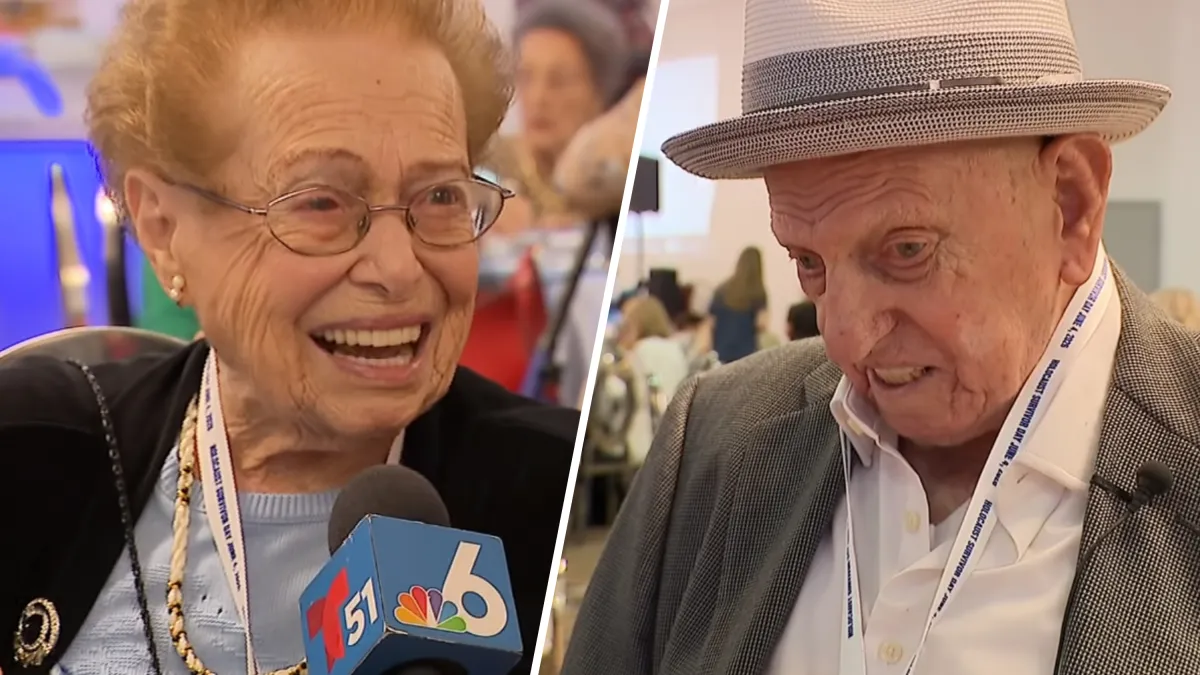
In honor of Holocaust Survivor Day on June 4, roughly 130 Holocaust survivors gathered together in Cooper City.
Read more Baby alligator bites man, 78, after releasing turtle at lake in Pompano Beach, Fire rescue says
But get this – among them, nine survivors are celebrating 100 or more years of life.
For some, like Betty Eisdorfer, age is just a number. She’s 101 going on 102.
But for others like Leon Schagrin, 100 years of age means so much more
“It’s 100 years of history. 100 years of suffering,” he said. “It’s very hard to get away from something that is with you for 100 years.”
And 101-year-old Herman Haller feels the same way. He recalled an encounter he had with a Nazi guard during his time in Auschwitz.
“And he said to me, ‘What is your name?’ And in the moment, I wasn’t thinking, and I said Herman Haller. And he said, ‘What is your name?’ And I realized my mistake, I should have said I am a prisoner, a Jew under protected custody, and my number is 72,554,” Herman said. “And he turns around and says, ‘Follow me, I have to teach you to not forget your name.’”
Herman said that the guard put him in a room and told him to do 100 knee bends and count them aloud. When Herman got to 20, the guard said he could not hear him, and he had to start again.
After Herman finished, the guard asked again for 100 and asked him to count backwards. When Herman used all of his strength to finish that task, he was told to do 10 pushups. Once he completed them, he was forced to do 10 more.
Herman recalled he couldn’t move his body anymore, and that’s when the guard took out his gun and asked for 10 more pushups or threatened Herman would be shot. Herman completed the task and was allowed out of the room, where he found his friends outside waiting for him to report to work. Herman said he knew he couldn’t report himself as sick, so his friends helped him.
Read more Florida secures $1.5 billion in FEMA reimbursements for hurricane recovery projects
Herman said they worked at a factory at the concentration camp that worked with spare parts. The workers were put into 100 columns in rows of five, and Herman was put in the middle by his friends to be able to support him in his frail state.
Once at the factory, his friends stored him in a cabinet while they worked at night. Herman recalls hearing sliding doors open, and two Nazi guards who were supervising their work walked in. While they had a smoke break next to the cabinet he was inside, he remembered he could clearly hear the two talking, discussing how they saw the Jews burning in the distance because of the plumes of smoke.
“I’m glad that I am alive, I got liberated by the American Army,” Herman said with a sad smile.
He was taken to a Belgian hospital, where he was for a year. He had family in America, and while they were looking for him, he was looking for them. He said that they sent him papers, and he was able to come to Florida.
Herman’s story is just one version of what so many others in the ballroom at Cooper City went through. But fewer every year get to share their story. This is why nine Holocaust survivors and centenarians were recognized and inducted into the Goodman Jewish Family Services Centenarian Club, so their remarkable stories and feats can live on in future generations.
To learn more about the 2026 inductees, here are more details provided by the Goodman JFS of Broward County:
Read more Parents, 2 girls found dead in apparent murder-suicide in Doral, MDSO says
Leon Schagrin
- Born in Grybów, Poland, on October 30, 1926.
- At age 14, he was deported from occupied Poland to multiple ghettos and concentration camps, including Tarnów, Szebnia, and Auschwitz III (Monowitz).
- He endured forced labor and witnessed the murder of his entire immediate family at Belzec.
- He was liberated by the Soviet Army on January 27, 1945, and later immigrated to the United States.
- In 1982, he co-founded Holocaust Survivors of South Florida and dedicated himself to survivor advocacy and Holocaust education.
- For nearly four decades, he sought reparations from Germany and spoke publicly to students and community groups, urging that no Holocaust victim be forgotten.
- His memoir, The Horse Adjutant: A Boy’s Life during the Nazi Holocaust (2011), recounts how the horsemanship taught by his veterinarian father became a means of survival and a witness to both atrocity and humanity.
Saul Dreier
- Born in Krakow, Poland, April 29, 1925 (101)
- He 14 years old when World War II broke out in Poland and lost many family members.
- He is the founder of the Holocaust Survivor Band, created in 2014.
- The band is recognized globally as one of the most famous and celebratory Holocaust survivor bands.
- We perform concerts across the United States, Europe, and Israel, under his direction and with the support of Justine Kolaczek.
- At the age of 100, with G-d’s help, he continues to play music.
- He is always willing to play for humanity and share his story through music.
- His goal at over 100 is to remain active and hopeful to
- Talk about the past
- Live in the present
- Contribute to the future
- I send my warm regards to people around the world, especially to Holocaust Survivors who share in this cause.
- He is thankful to Goodman Jewish Family Services for:
- Inviting him to Holocaust Survivors Day
- Giving him the opportunity to share my story and legacy
- Providing him with daily support, including:
- Homecare services; his dedicated home health aide, Patricia
- He is deeply grateful for their care and support, from the bottom of my heart.
Liliana Ferber
- She was born in Poland and had a brother and sister.
- She was in a ghetto and was hiding (she was not caught)
- She survived because she did not look Jewish
- Her father had taught her German which helped her survive during the war
- She was shot by a German soldier which flew right next to her ear
- She was taken to the forest to be shot. She survived but was sent to a ghetto
- She doesn’t like to talk about the war.
- She returned to Poland and then moved to Israel for 10 years. She learned bookkeeping and accounting and learned Polish, German, Hebrew, English, and French so she was able to get a job in Israel.
- She was married in Israel and moved to England and had a son
- Her son was killed in England at 18 years old
- They moved to the US to join her mother who was already here.
- Her husband was a dental surgeon, she became a dental nurse
- She was very pleased to have recently received a signed birthday greeting card from King Charles and Queen Camilla in honor of her 100th birthday
Rosa Lindenberg
- Born in Wuppertal-Elberfeld, Germany, March 31, 1924 (102)
- She was exposed to bullying and anti-semitisim in school as a child. Her father’s store was forced to close, and the windows were smashed by Nazis.
- She experienced Kristallnacht on November 9, 2024.
- She was smuggled to Belgium and lived with a family and then was on the Kindertransport to England.
- After the war, Leo, the son of the family she lived with in Belgium, found her and they were married in 1948.
- They moved to New York and had a son and daughter.
- They eventually moved to Florida. She was a hostess at Wolfie’s and Pumpernicks.
- She has 4 grandchildren, 5 great-grandchildren and 6th great-grandson on the way.
- She Believes you must live with hope and that tomorrow will always be a better day.
Herman Haller
- Born in Berlin, Germany, July 6, 1924 (turning 102)
- October 31, 1942, he was sent to Auschwitz. He was #559 from the 16th transport that was sent to Auschwitz; there were 848 man, 94 women and 41 children; a total transport of 983 souls. Only 54 men survived. To this day, he has a copy of his transport record.
- On January 18, 1945, the Russian army moved up from the east and they could hear the artillery fire. The Nazis decided to evacuate Auschwitz.
- He was on the Death March to Breslau, and in Breslau they were put on open cattle cars. There were 110 people in his cattle car. They were in the car for seven days without food or water. They ate snow to survive.
- When the cattle car arrived in Buchenwald, there were seven of us that were alive.
- On the morning of April 11, 1945, American soldiers liberated the camp. He was 55 pounds, and so sick that if it had lasted another day or two, he would not be here to tell this story.
- On May 5, 1945, the American Army placed him on a transport plane to Brussels Belgium where he was treated by Belgian doctors and after regaining some strength and with the aid of Jewish agencies, he was able to contact his relatives in the United States. In September 1947, they sent him the necessary papers to immigrate.
- He lived and worked on a farm in New Brunswick, New Jersey and later went to New York City and got a job working in a factory. He took advantage of all types of on-the-job training and taught himself much through the library and “how to” books electrical work. He was able to take a test for the New York City Transit Authority where I worked in the signal department.
- He joined a social club for people who were immigrants from Europe, and met my wife Lore there, a transplant from Heidelberg Germany.
- They got married on December 25, 1949, and were married 73 years till his wife passed away. They have 2 daughters, 4 grandchildren, and 3 great grandchildren.
- With gratitude, he needs to say “God Bless America” that gave us shelter and opportunities to rebuild our families and our lives.
Betty Eisdorfer
- Born in Rulzheim, Germany, September 29, 1924 (turning 102)
- In 1939 she went to England with her younger brother on Kindertransport.
- While in England she attended nursing school.
- She came to the United States in 1947 and lived with her aunt in Washington Heights in
- New York City.
- She worked as a nurse and married her husband in 1948.
- They had a son and daughter and moved to Long Island City in Queens.
- She enjoyed cooking, needlepoint, and embroidery.
- She has 5 grandchildren.
- She moved to Sunrise Fl in 1996.
David Elefant
- Born in Ciumarna, Romania, December 18,1924 (turning 102)
- He had 4 sisters and 3 brothers. He learned to be a cabinet maker.
- Both parents and all brothers and sisters were taken to Auschwitz, where his parents, 2 sisters and 2 brothers were killed.
- From Auschwitz he was transferred to Hirschberg and then to Buntzlau, where he worked at making fake airplanes.
- After the liberation of the camps, he went back to Romania, got married to Ileana and had two girls. His hobby was hunting and was very proud of his trophies.
- In 1972, he emigrated with his family to Israel, and lived in Kiriat Bialik, a suburb of Haifa, close to one of the sisters.
- In 1984, he came to America, to be close to his younger brother in Cleveland.
- He moved to South Florida, and lived with his wife, Ileana, until she passed away in 2019.
- They were married for 60 happy years. He lives close to his daughter.
Frances Gaspar
- Born in Itrshava, Czechoslovakia, April 9, 1921 (105)
- She was separated from her parents because she traveled to find work after her father lost his job. When she returned, she found that they, and her whole family, had been deported. The Hungarians had taken over Czechoslovakia, and she ended up in the Budapest Ghetto where conditions were dire, especially during the 6 weeks when the Russians and Hungarians fought for control of the ghetto and there were no supplies for 6 weeks.
- In 1944, she married her first husband and after liberation, they moved to Israel for 9 years of hard work, where her daughter was born.
- In 1957, they were sponsored to come to America. She became a clothing designer. Her husband died when her daughter was 16. She later met and married the father of her stepson. This was a happy marriage, and she mourns his loss to this day.
- She now spends her time in both FL and NY and is happy to have the love and support of her daughter and stepson, their families, and 7 grandchildren.
Hana Altarac
- Born in Sarajevo, Yugoslavia, January 31, 1920 (106)
- Hana married her husband Isak in 1938 in Sarajevo.
- In 1938, Hana and her husband made it on the last train from Yugoslavia to France through Italy before Italy closed its borders. From France, she then traveled by boat to Algeria.
- During the war in Algeria, Hana and her family had to register as Jews. Hana and her family remained in Algeria after the war.
- Unfortunately, Hana lost many family members in the war including her father, sister, sister-in-law, and niece in the Dachau concentration camp. Hana’s two brothers survived the war as part of the Partisan Resistance.
- Hana and her family moved from Montral, Quebec in 1966 to the United States.
- Hana had three daughters with her husband, has seven grandchildren, 35 great-grandchildren, and 17 great-great grandchildren.
- Hana loves to take care of her family and has done so throughout her whole life.
- She enjoyed gardening while living in Algeria. She now likes to spend all her time with her family and play her favorite computer games.