
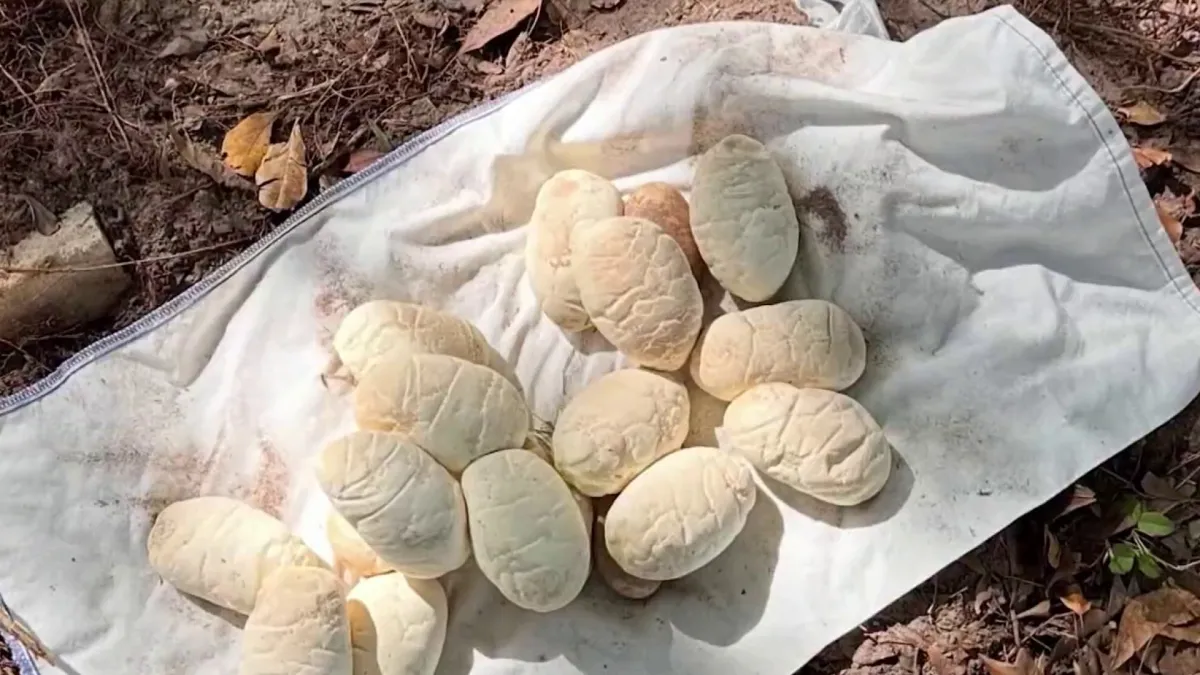
We are right in the middle of Burmese python nesting season in South Florida, and one recent discovery is highlighting just how adaptable this invasive species has become. A python was found hiding underneath a sidewalk, guarding 20 eggs.
Read more Fact-checking DeSantis: Would his plan exempt 60% of Florida homeowners from paying property taxes?
The snake was discovered by a man walking nearby, who noticed movement under the concrete. What he saw next was something most people would never expect in a neighborhood setting.
A Burmese python was slithering beneath the sidewalk.
That is when contractor Guillermo Tapanes stepped in. He works with the South Florida Water Management District and quickly realized this was more than just a routine sighting. According to him, this is just another example of how resourceful these animals have become in South Florida.
“They utilize our waterways, our canal systems,” he said. “They are very buoyant and use canals to move around. The one I found under the sidewalk is proof of how adaptable they are.”
How fast can pythons reproduce?
While 20 eggs may sound like a large number, it is actually small compared to what Burmese pythons are capable of producing.
Tapanes says larger females can carry dozens or even hundreds of eggs at a time. He recalls recent cases where a 14-foot python was found with 53 eggs. In another case, a nearly 18-foot female had not yet laid her eggs, but had an estimated 200 already developed inside her.
The discovery comes during what experts say is the peak of nesting season. Although the eggs will not hatch until early fall, removing them now is key to controlling the population.
How Burmese pythons ended up in Florida
Burmese pythons have not always been part of Florida’s ecosystem. Many were first introduced through the pet trade, back when it was legal to own them, and some were later released into the wild when owners could no longer care for them.
A major moment came after Hurricane Andrew in 1992, when a breeding facility in the Homestead area was destroyed, allowing more snakes to escape into the surrounding environment, according to Tapanes.
With South Florida’s warm and wet climate closely matching their native habitat, the species has been able to reproduce quickly and spread over time.
Read more Deputies respond to armed man barricaded inside Oakland Park apartment
Tapanes says activity is already ramping up.
“In the month of May, we have captured 23 so far,” he said. “Since I started as a contractor, I have caught over 100.”
Python threat to pets and wildlife
Because Burmese pythons are an invasive species in Florida, state law requires that they be euthanized after capture.
“We follow American Veterinary Association standards for humane euthanasia,” he said. “They are not native to our area and are disrupting the ecosystem.”
The threat extends beyond wildlife. These snakes are opportunistic predators, meaning they will prey on whatever is available, including pets.
“We have seen them near neighborhood lakes,” Tapanes said. “For them, it can be a cat or a dog if they are hungry.”
That is why experts are urging the public to report sightings immediately. One of the easiest ways to do that is through the IveGot1 app, which allows users to quickly notify wildlife officials.
As temperatures continue to rise heading into summer, sightings are expected to increase across South Florida.
Officials say staying alert and reporting encounters can help slow the spread of this invasive species.
Read more Who wins and who pays? Inside DeSantis’ new property tax proposal